Without a Paddle
Ponderings of an Uncommon Life
The Golden Rule Applied

It has been nearly two weeks since Helena got her second set of casts. The change has been for the most part a huge relief. She had a huge pressure sore forming above her knee that they caught fairly quickly. When Dr. Karol changed the casts, she more heavily padded the right one, and moved the bottom of the upper cast up to where the sore could heal. It has felt much better for her up until the past couple of days.
The evening after the second procedure, we went outside for a picnic to celebrate our anniversary. It was lovely weather outside that night! Helena went over and played on the playground after we ate. She sang and smiled and slid down the slide – I didn’t realize it until that moment, but Helena had stopped singing during the first few days of casting, which is a significant departure from our normal routine. Pain can sure change behavior.
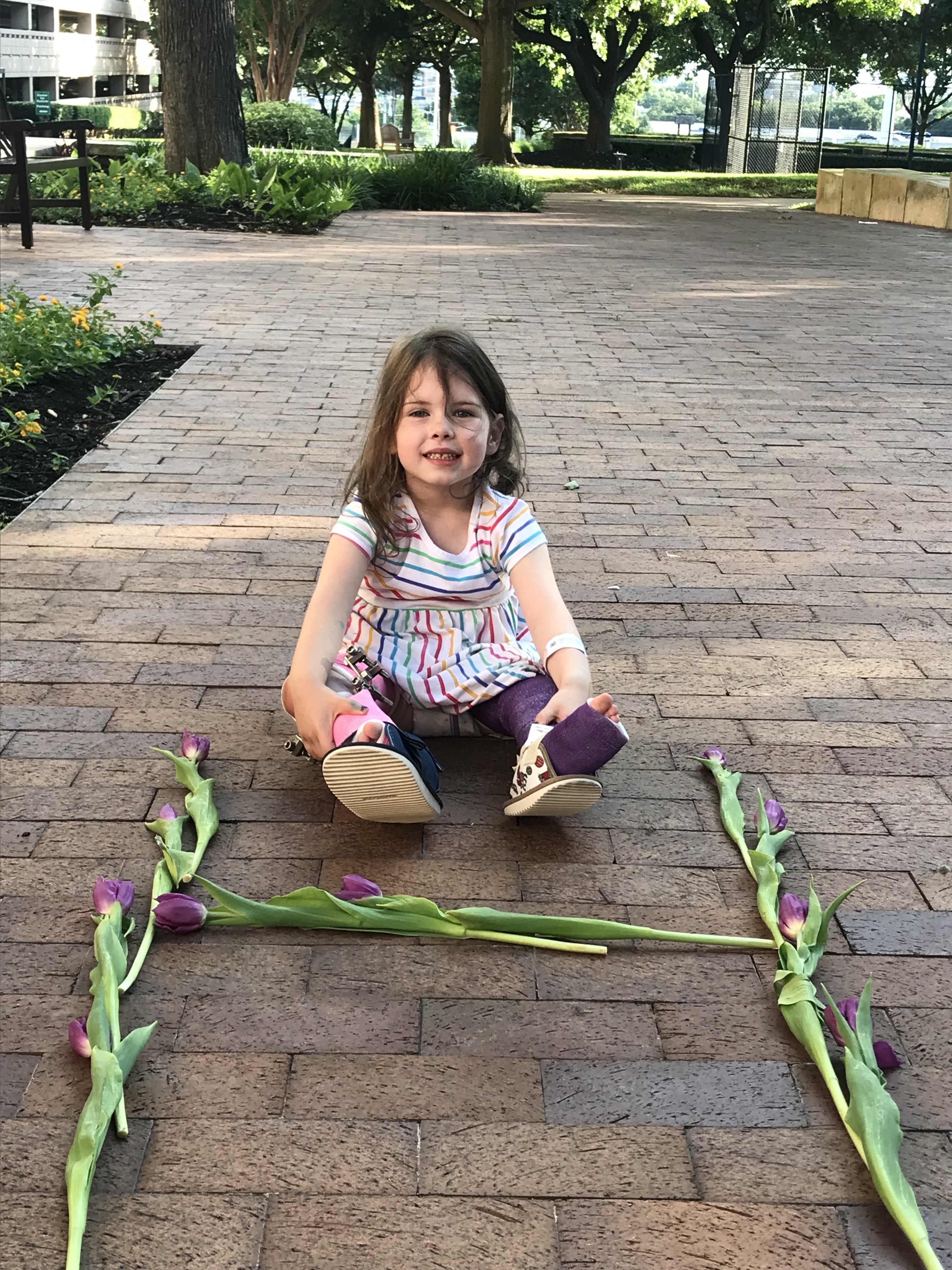

Despite feeling better than before, Helena was very angry that “those things” were still on her legs – and she is still in a lot of pain, mainly after the hinge bolts are turned. When we told her we were getting the casts “fixed,” I think she thought we were removing them for good. She woke up and saw that she had that dreaded IV back in her hand, and new casts were there. “They didn’t fix them- they put on more casts,” she wailed as we moved her back to her room.

As the casts are straightened in this procedure, the pressure of the cast shifts. In the beginning pressure is not so uncomfortable on the front part of the leg. However, as the cast is straightened, it creates more pressure toward the front of the thigh as the knee is straightened. It is also not a comfortable procedure because it is stretching her entire leg, down to her heels. But the process is working beautifully; she just got her last set of bolt turns and will be exchanging the hinges for two long hard casts Monday morning. Then we can go home for a little while!

Dr. Karol describes Helena as being “fiercely independent.” This is absolutely true. As a result, Helena has been struggling with being polite to her caretakers. Our biggest arguments are over taking medicine and doing things independently. I started an incentive chart with her – every time she is polite, she gets a sticker. Every time she takes her medicine without a fit, she gets a sticker. It has helped some – but sometimes, she just doesn’t feel well. And the last couple of days, it hasn’t worked much at all. She is four- who can blame her, I suppose? But I feel like we should be holding her accountable on being polite in any situation. There are too many excuses for not being polite these days.

While Her frustration is certainly understandable, it is not in her best interest to give her a free pass to engage in rude behavior, even if this is very hard. So we are continuing to point out her mistakes and challenge her to improve. She has gotten better about speaking kindly to caretakers – but it is a work in progress.
In doing this, I have been frequently repeating a phrase my teaching friend LuAnn would often say to her students (and we discussed often as teachers who work in sometimes challenging situations): “ALWAYS act nicer than you feel.”
Acting nicer than you feel is just another way of putting the Golden Rule. Some might even say it is the “impossible rule.” It is easier said than done, even for an adult. Our media and culture certainly has not been demonstrating this ideology in front of our children, who get more technology and inappropriate entertainment than they need – and for Helena, this concept Is definitely a challenge right now – because she rightly believes her caretakers are responsible for her pain.
This particular pain is going to improve things for her – but even if it wasn’t going to change a thing, we would still expect her to be kind to others. We have noticed that when Helena throws fits and is uncooperative with her caregivers, she is also complaining more about her pain level. When Helena is in control of her emotions and is positive and kinder toward her caregivers, she is able to tolerate the pain and continue to interact with her surroundings. A positive mindset influences how one experiences pain and responds to difficult situations, so it is in Helena’s best interest to help her maintain a positive mindset.
Even without her current situation and the need to stay positive, there will always be hard times to face and excuses to be angry. There will always bad situations – and we control our response to these situations. There will always be times when we need help and have to allow others to be there for us. And we will always have things to make us feel bad – but we can always choose to feel a little better and receive encouragement by being kind to others. God loves us. And beyond His greatest commandment, God’s command is to love others as we love ourselves. That includes when we feel bad, when we are angry, and when we disagree with someone else.

There are many versions of the Golden Rule hanging outside of the chapel in the hospital.
Today, Helena gets to leave the hospital for the weekend before getting her hard casts on Monday. As we prepare to go, Helena has already been rude to the nurse, and when I asked her why she has been acting rude, Helena’s reply was simply, “I don’t know.”
I told her once again, “Helena, we know you are tired of being here and your leg is sore. But you have to try to always act nicer than you feel. God loves you and God loves the nurses and doctors. They are trying to help you because they care about you. You need to try to be polite.”
Not long afterward, Dr. Karol came in to tell her goodbye. She has been great about coming to see her every day. Here is their conversation.
Dr. Karol: Good morning, Helena! I came to say goodbye. Can you say goodbye to me?
Helena: (looking away, saying nothing.)
Dr.Karol, looking at Helena’s bed: I like your pet snake. What is his name?
Helena: (nothing)
Me: His name is Fred, isn’t it?
Dr. Karol: I like that name. I think I would have probably named him “Slithers.”
Then suddenly, a little lightbulb came on.
Helena (To Dr. Karol): We saw a fuzzy caterpillar. It was at the farm!
Kind conversation is a start. Progress, not perfection is what we hope to see. We are so grateful for the patience and love given to Helena by Texas Scottish Rite Hospital for Children.

4 Comments on “The Golden Rule Applied”
Leave a comment
Recent Comments
 | mrgriz on The Stolen Summer |
 | musicamom07 on Up and Walking |
| mrgriz on Up and Walking |
 | allyeon on Up and Walking |
| musicamom07 on Helena Update |
 Without a Paddle
This is the first I’ve read your blog, Jennifer. I’m so glad to have found it. Your daughter is so beautiful. And you all are going through so much. You are a strong person to keep teaching her to be kind even when she’s going through a lot. Of course you’re right. Much love!
LikeLike
Dearest Jennifer,
Your heartfelt blog is a highlight of my day each time you write. You are a quite good writer as I remember Mopsy, your great-grand mother to be. Bless you.
As you are also turning into a quite good psychologist, as most good teachers do, I think you might appreciate some of the work they are doing at HeartMath.com. They have some exercises you can do with adults or children that might be helpful right now even without having to by their device for your phone. I hope you will see what they are teaching us all about a more heartfelt way of living and being.
LikeLike
Thank you, Aunt Gloria! I have been reading a lot about discipline and behavior lately, so I can benefit from this greatly – both for Helena and for
my job. Helena is more
Challenging than my others were – partially due to her different experience. But also – my students at school in Marble Falls are very different from any I’ve taught before. I don’t know if it’s parenting or technology interference, but they really are not coming to school prepared with adequate social skills. My blog is helping me with processing a lot of what we experience – and hopefully is helpful to others!
LikeLike
Thank you
LikeLike