Without a Paddle
Ponderings of an Uncommon Life
“Growth” Mindset
When I was little, my mom had an amazing garden that she loved very much. I remember walking into it impressed by the variety of vegetables she had growing . For years, I couldn’t eat canned green beans from the store, because they just didn’t taste the same as the ones from her garden. And the first pickled okra I ever remember having was grown in my mom’s garden.
This Spring, I have been working hard at my own gardening project. Stuart’s family owns a ranch with a small pecan bottom, and that is where our garden grows. One day soon we will be living out on that property.

Measuring around 12,000 square feet, our garden contains numerous types of vegetables and fruits – corn, squash, beans, cucumbers, strawberries, and chard, just to name a few. We have berry bushes, a peach tree, and designated space to add more trees soon. We will also have watermelons and cantaloupes in July. I tilled it, built the rows, planted it and have tended it mostly myself – with a little bit of help from my kids and family. Being out there always makes me happy – and provides me with time outside that I have really missed since I have not been band directing this year. (I never realized how much I’d miss that part of my band gig!)
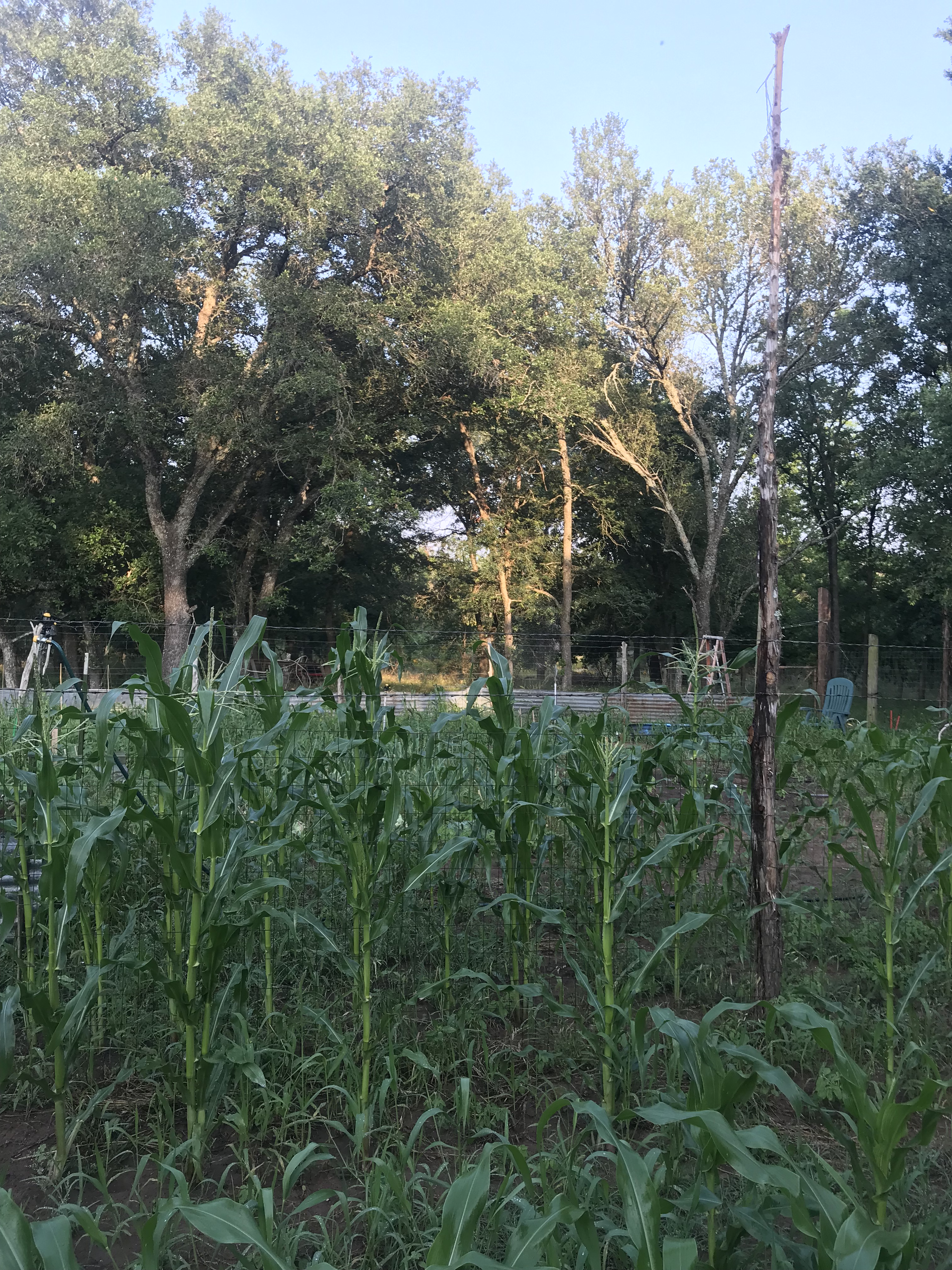
I almost didn’t do a garden this year. Helena will be going into the hospital on June 4 to start a lengthy casting procedure that will involve the majority of the summer. She will be in the hospital in Dallas for 4-6 weeks, far away from my garden, then will be in a hard plaster cast for 4 weeks.. I will be staying with Helena throughout her hospital stay. When I realized the significant amount of time we’d be in the hospital, I wasn’t sure it would be worth my time and energy to work on a green. I kept thinking – why start if I can’t be there to finish?
After a lot of thought and a discussion with Stuart, I decided that it would be worth starting the garden for the simple purpose of finding out what will work. We decided to go about this by starting lots of seeds in our greenhouse. Seed starting was something I needed to improve upon, so it was a positive use of time. To my surprise, most everything came up!

Next, I had to learn the best way to keep the plants alive coming out of the greenhouse. If you put them out too early, they will die out. If you put them out too late, you stunt their growth.
Since late February, I have been going out to work in my garden at least a couple of times per week after work and on most weekends. There are lots of weeds, bugs, and at times, snakes (yikes) — and it is hard to keep up with that part, but we do what we can. The garden has taken up a lot of time and effort – but the rewards have been fully worth it!

I have also spent a lot of time reflecting on how hard we have worked to get Helena to “grow” — and to do the things that others do without thinking. Helena has worked toward the goal of walking independently since she was born! For her, whether growth in this area was “worth it” is a non-negotiable issue. It must be a part of her daily life. She has to come up with solutions as to how to do many things. Just as a garden brings sunlight and freedom to stay away from a grocery line – the solutions we come up with bring her invaluable independence when they finally bear fruit.
As with our garden planting experiments , we have had to experiment with different ways to help Helena – she is truly one of a kind. Some experiments work, some don’t. We purchased rattles with the goal of encouraging arm movement. We purchased phone apps for the sole purpose of distracting Helena when doing stretches daily. We bought several tricycles based on the distance of the pedals from the handle bars and the degree angle between the axle, handle bars and pedals in order because it was worth the try. We bought monkey bars to enhance upper body strength, and played balance games on the Wii. Stuart has built special toys to encourage certain types of movement. And we use lots of toys non-traditionally. Just like choosing which seed to buy or which organic pest control method is best, much time has been spent analyzing tasks and trying unconventional ways to encourage movement. All of that effort has culminated in some great growth and independence for Helena.
As we prepare to take Helena to Scottish Rite Hospital in Dallas next week, we will be preparing ourselves for yet another unconventional way of treatment. Quengel casting is not a common procedure for AMC. It was previously used on polio patients, and recently been revived as a treatment option that doctors are now trying as an alternative to surgery. Most kids with arthrogryposis have multiple surgeries before they turn 18. These surgical options, while very necessary at times, could eventually result in a buildup of scar tissue and affect her as an adult. The Quengel casting option is lengthy, but is a non-surgical method that we feel is worth a try.
Our family has never been the type to just jump at the most convenient option. Sometimes the lengthy path to a desired result is the best in the end, and reaps the greatest rewards. And so I will bid my garden farewell in a few days. Worth it? You bet.
Everything worth doing in life requires work.
“Far and away the best prize that life has to offer is the chance to work hard at work worth doing.”
―
Perfection Redefined

The month of June is Arthrogryposis Awareness month. As we go through this month, I hope to reflect each day on our experiences with Helena’s condition. AMC is an umbrella condition that affects around 1 in 3,000 births. This post, originally published on May 19, 2019 when Helena was 4, is the first reflection.
“Something’s wrong, isn’t there?” I asked Stuart immediately after the ultrasound technician left the room. We were at our 20 week checkup, excited to find out that our baby was a girl. But the technician was just a little too quiet, and a little too focused on her work.
“Try not to worry,” Stuart said. And then he continued trying to distract me from what he saw going on. His distractions had been working for a while — until I finally noticed that the technician was concerned.
What I didn’t realize until later was that they were having trouble detecting her heartbeat. The technician was also alarmed because there was no evidence of movement. When she returned to the room, she brought another technician back with her and they found Helena’s heartbeat. After they finished looking at some other measurements, they explained that my doctor needed to meet with us. My heart rate soared, my blood pressure went up, and I sank into sorrow. What was wrong with the baby?
A couple of weeks later, we met with a neonatologist and were told that our daughter Helena would be born with a condition called Arthrogryposis Multiplex Congenita (AMC). AMC affects 1 in every 3,000 births and is defined as the development of multiple joint contractures affecting two or more areas of the body prior to birth . The neonatologist noted that Helena had clubbed feet, seemed to be in a lotus position, and had straight arms. The doctor explained that there was really no way of knowing how severe it would be until she was born. We were told of the possibility of limited locomotor movement, possible breathing problems, and difficulty doing many of the daily tasks of living that most of us take for granted.
I was furious after this diagnosis. I was mad at the ultrasound tech. I was mad at the doctor. I was mad at the nurses who took my blood pressure and vital signs. And I was mad at God. How could God allow this to happen to my baby – or any baby? No one knew if she would be able to care for herself, or even breathe without help. The worst part for me was that I could do NOTHING to help her, or so I thought. I sulked and stewed for days over the fact that this time, I could not control the situation I was dealt. I talked with Stuart about my anger on numerous occasions, and at one point, Stuart finally said this:
“Jennifer – who are you to think you know better than God what is best? God made Helena in his image. He doesn’t think anything is wrong with her. He thinks she is perfect the way she is. Who are you to judge God’s perception of what is beautiful and complete in His eyes? God thinks Helena is His perfect creation, created in His Image and you need to wrap your brain around that.”
Stuart’s words were both honest and perplexing. How can God think this situation is perfect? Is he kidding me? The more I thought, the more my questions changed toward conviction: If this was God’s vision of perfection, then why was I judging God’s decision about what was perfect? Why did I have the idea that God was unable to work through this situation as he had in so many other moments in my life? Who was I to limit God?
As I sorted through an array of questions and emotions, I was able to move forward and learn more about AMC and parenting a child with a disability. It has been a journey much like going up a creek without a paddle because every AMCer is different, and very often, we are doing things very few others have had to do. Making decisions in this situation can be very isolated and lonely. What we have learned most of all is that what we think God considers to be creative perfection isn’t really the case – we limit God in so many ways, and in doing so, we limit ourselves, we limit others, and we limit what is possible. Helena is now four and a half — and If I had been able to look forward, I would have been relieved to know that there is no limit to what the future holds for her.
A Trip to Buy Shoes
Note: This post is originally from January 2018, not long after Helena got her first set of long braces at age 3. That being said, shoes have always been hard to find! This post was a reflection on my frustration from shoe shopping one day.

I have always hated buying shoes. I have large feet and from a very young age, have had to special order shoes – especially if I want something trendy or comfortable. When I walk into a shoe store, the first thing I do is look for the size – then I look for the style. There is no point in finding a shoe style I like only to find that there is none In my size. Most stores don’t go past a size 10. This evening, my hatred of shoe buying has reached a new level- but not for my own woes.
Helena, who has arthrogryposis multiplex congenita, wore a hole through the bottom of her tennis shoes for the first time, and last Friday we went shopping for new ones. Helena’s orthopedic impairment requires her to wear KAFO’s (Knee-Ankle-Foot Orthotics). The brace she wears is a long plastic formed sleeve like a boot with an open front and Velcro straps. They are to be worn with shoes – and with a raised heel in the brace, that is a challenge.
Her first set of shoes were modified by her orthotist. The Velcro straps had to be lengthened to where they would strap closed over the foot. My goal tonight was to find better fitting shoes that didn’t need modification, if possible. You would think with the wide variety of shoes out there, that wouldn’t be such a big thing. But it is.
We tried on shoes with Velcro, boots with zipper openings that can be opened wider, high tops, Mary Janes. We tried on her size, and the next size up, 2 sizes up, and 3. We probably tried on 20 pairs of shoes.
At one point Helena decided she had found “the” pair of shoes. She pointed out a pair of apricot colored Mary Janes with a pump heel 3 sizes too big. I explained that these were not going to fit, but she insisted on trying them. I giggled as she tried on the princess shoes – and Stuart chided me. “You are laughing at her. Please stop.”
“I am laughing because she is cute,” a little frustrated and not even thinking about her disability.
“She doesn’t know that is what you are laughing about,” Stuart said.
Then, it hit me.
Helena will more than likely never wear that type of princess shoes. She will more than likely always have to get something “sensible” – even for her prom, and her wedding – for every special event. She will most definitely always have to wear braces. And I will always have to be careful when I laugh because it could be misinterpreted
We will likely always have to try on 20 pair of shoes, and there may be no guarantee of finding the right pair after the 20th. And while Helena thinks it is great fun right now, one day, she is going to detest it. Probably much more than I ever did.
I cried.
“Mommy, why are you sad?” Helena said.
My sadness for her is not something she needs to understand right now, and I don’t know how to soften the blow for her later. Are shoes really so important, and if they are, why isn’t it easier to find pairs for people who are not average? Why are we so concerned about such unimportant things when we should be grateful to just have a well-fitting pair? It makes me very angry that while the majority of the world looks for fashionable shoes in a wealth of options, Helena will be scavenging for shoes that are functional.
Today, the main comment I got on Helena’s new shoes was, “so — these shoes are a little too slick on the bottoms, aren’t they?”
If they only knew.
 Without a Paddle
Recent Comments