Without a Paddle
Ponderings of an Uncommon Life
Faith Informed Action
In December, Stuart, Helena and I went to Dallas to see Helena’s neurologist. A few months earlier, we did whole genome sequencing to look for possible causes of her condition. After a long wait, the results were finally back.

Almost every person has some genetic mutations in their makeup. What is more rare is when those mutations work together to cause a medical condition like Helena’s.
Helena has a genetic mutation from both of us that contributes to her condition. This genetic condition can cause muscle weakness, contractures, and cardiomyopathy.
Based on this information, we visited a cardiologist in January. We had an EKG, and after the results were in, we were relieved to find out that Helena’s heart is fine for the moment. We will go back for a follow up in 2 years unless something new comes up.
No one can determine when cardiomyopathy will show up – just that it is a likely possibility to eventually occur based on this testing. Along with genes, external factors like illness can play a role in when this happens.
In February, Covid-19 started spreading in the US.
My husband had been watching information about this virus since December out of personal interest because of an early news story he heard. He has some experience working in the chemistry lab of a pharmaceutical company. He understands pretty well the potential harm a new virus can cause, and was a little concerned about this report.
I was more in a state of concerned denial. In February, I went to my work conference in San Antonio, mostly unconcerned about any sickness other than the flu. I had a rough bout of the flu or an illness similar to it in December. I didn’t want to feel like that again, so I avoided being in large crowds like the food court as much as possible. All of my sessions were packed with participants, as always. After I returned from my conference, I heard of a woman with this virus going through a San Antonio mall.
In March, we had planned to go to a car show that benefitted Scottish Rite Hospital. As the virus progressed, we thought it might not be a good idea to go. There were too many unknown factors about the virus, and seemed to be too many people traveling when they could avoid it. It still bothered me to hear that people were stocking up on groceries and supplies. By the end of our Spring Break, most schools and universities had closed and Stay at Home orders were being issued.
Our effort to follow the Stay at Home Order was mostly out of a proactive concern for our parents, and just a mild concern for Helena. After about a month of being home, however, I read a newsletter from an advocacy group for Helena’s condition discussing hydroxychloroquine, which was a hot topic at the time.
In this letter, two cardiologists were weighing in on the dangers of hydroxychloroquine. Both agreed that for high risk populations, (such as this genetic condition), this drug should not be used due to potential heart problems that outweigh the drug’s benefits.
So my curiosity was piqued. Was Helena actually considered high-risk because of this new diagnosis? We decided to check with her neurologist to make sure. We were not all that concerned, but didn’t want to be caught unaware.
The next day, I contacted her neurologist’s office and inquired about her status. The nurse responding to me didn’t seem too concerned, either. However – I when I got a message back, this was what the doctor said:
“The doctor has stated she is recommending all of her patients stay home from school until August.”
At that point, the Stay at Home order became more significant for our family. The more we researched her genetic results and considered all of the information we currently have about Helena’s condition, we knew that we would really need to continue social distancing for longer than others. Helena is doing very well right now, and we don’t want this to change because of poor choices.

I have been seeing a lot of people recently posting things about the Pandemic in social media like “Faith Over Fear.” I know that this sentiment is partially being shared because of the frustration with media coverage of the virus. However, it bothers me a lot when I read these posts.
I tend to weigh most decisions on my faith, and many people might even say I rely too heavily on my faith. My decisions regarding Helena’s condition are always made with a mixture of prayer and good information- which I believe God is providing to us through excellent doctors. One thing we do know – doctors do not always have all of the answers when it comes to rare conditions, and are many times dead wrong. Faith is required.
That being said, I believe this is not the best message that Christians could be sending out to the world right now. This virus is real – and at this point has killed over 477K people and infected over 9 million. We should be concerned and looking for ways to support those affected and at highest risk. We should be thinking about our own family members, and it is NOT fear to base decisions on the information we have.

At this time, I believe Christians should instead be promoting “Faith-Informed Action.”
In Proverbs 16:3, it says “Commit your works to the LORD, And your thoughts will be established.”
Christians should be seeking God’s Will through scripture and prayer for their own personal circumstances and for opportunities to serve those around them. Every person’s situation is unique and requires close examination.
Now that it is mid-June and Stay at Home Orders have been gradually lifted, people seem to be in this odd place – one where many are out and about, but others still need to remain cautious and stay home. There are valid concerns for those who need to be cautious. Where I am, the number of infections is starting to rise sharply again. Along with this, I see no consistency in the way social distancing is being handled.
How does someone go from staying at home – to safely social distancing? And what if someone works or needs to interact in the community with a high-risk family member at home? How are at-risk family members kept safe? Here are my thoughts:
1. Set your family goals based on the needs of its members.

Credit: Sarah FoyeOur family’s plan is to stay at home as much as possible until we have to go back to work on site. When out, we will continue to social distance. For us, there is no reason not to continue social distancing right now – and Helena deserves our protection. It is our job as parents to set in practice the best way to keep family members healthy. Others may not have these risks and that is fine. We do- and we should be taking them seriously.
2. Showing kindness and empathy to everyone.
I am sure there are many who are having to return to work or have been working as essential employees who are vulnerable to sickness or have to work in high risk areas. There are many who have lost jobs or have had other difficulties during this time.
Every one of us have been dealt a situation that is unprecedented in history during our lifetimes. We should be slow to speak, slow to get angry, and quick to listen. And if we can meet a need – we should try to be supportive and help in ways we are able.
What we should not do: dismiss others’ concerns as wrong because they are not our own concerns.
3. Be open to being vulnerable, yet remain strong.
Anyone who truly knows Helena knows this – she is fiercely independent. Our main arguments with Helena tend to be over her desire for independence and how that desire collides with our understanding of her vulnerabilities. We don’t limit her much physically – but often we have to set boundaries when it comes to behavior and safety.
To state that we are staying home “out of fear” is absolutely wrong. Helena needs to continue to stay home because that is what is best for her at this time. We need to support her by doing this while we are able to do so.
The past few weeks have been difficult for me personally in terms of seeing the differences in philosophy on the handling of Covid-19. I have been especially guarded about discussing our family’s situation because of prevailing opinions in my area over the seriousness of the Pandemic. It has made me sad to disappoint a number of people I care about by having a differing viewpoint. There is a lot of unkindness in this world right now. There also seems to be little tolerance for differing beliefs – or even just being different.
The Covid-19 Pandemic is very real for us and could be life-changing for Helena if handled carelessly. Seeking God’s will is very important when so many people and bureaucrats are weighing in with their opinions. The care Helena receives or does not receive at this time rests solely with the decisions we make as her parents.
Even though many seem to be going back to business as usual, it is our belief that our family needs to continue social distancing practices. We have to stand strong on this decision. I am praying that the virus will weaken or that something else will happen soon to allow children with health risks to attend school without concerns over health. Our job is to protect Helena.

Staying at home has created difficulty for many who need to work. There are many families with at risk members who need to stay home, and we are living this situation at the moment. There are people who need to work and have to even though they should be staying home due to health risks. I just hope that as people return to normalcy, everyone can remember empathy toward those who need our protection or support. Christians should take most seriously the responsibility to love others.
You may not agree with everyone – but you can always be kind.

God is Enough
When it seems as if you have done as much as you can, but it isn’t enough
God is enough.
When it feels like the world is crashing down on you
God will carry it’s weight.
When it seems as though everyone is against you
God is for you.
When you think you are alone
God is there.
When you consider yourself a failure
God will direct you toward His success.
When you feel your loved ones have abandoned you
God loves you.
When you know your health is failing
God has plans for your complete healing.
When you messed up and can’t make it right
God will make something beautiful from it.
God is more than enough. For you – and for me. I often forget this. We often deny it – because we live in a society that highly prizes self-sufficiency and independence.
As I raise Helena, we have taught her to prize these things, too. In order for her to fulfill her purpose, it is important for her to be self-sufficient and do all of the things she can for herself.

But if we were able to carry the weight of this world entirely on our own, there never would have been the need of a Savior. There would not have been a reason to send a sovereign God down to earth as a tiny, vulnerable baby to grow up and die on a barren wooden cross.
The world lies to us. It tells us we should be able to handle it all – but that is false.
Our current situation is evidence of this. All of us (the whole world) are supposed to stay close to home, unless we are working in a job that is considered ‘essential.’ All of us are having to live a little differently from what we have ever experienced or remember. This situation is unlike any other we have ever experienced. We are not in control, no matter how hard we all try. We are not calling the shots this time. We can all try to fix things, but the truth in this situation is that our individual efforts are not enough.
But God is enough. He is stronger than COVID-19.
For the first time in thirty years, the Himilayas are visible in Northern India. The reason: Covid-19 closures have caused a decline in pollution to the point where they can be seen more than 100 miles away. God is trying to get our attention.
How could God allow us to be put in this situation – and why would God permit a sickness to so completely halt life for millions?
Maybe it is because we aren’t listening to him. Because we are distracted and think we have every right to do whatever we want to do – regardless of how many lives we affect.
Maybe it is because we are so busy that we barely notice the “smog” around us and we ignore our families to the point that when we are forced to be together we wonder why we chose to live such busy lives or we wonder what we ever saw in the stranger who lives with us.
Maybe God has just politely stepped aside for a bit, in order to show us our inability to handle everything, and to remind us to remember Him.
This is my prayer. That families find each other and grow closer. That businesses will start prioritizing quality of product over quantity of dollars. That lives – both those starting and those at their end will be prioritized, because ALL lives matter, and this has been a genuine tragedy for those who have lost loved ones. Finally – that society will fundamentally change for the better as a result of this trial and our response to its effects.
God is enough. He is greater than all of us. We need to listen for His voice and watch for His work around us.

What Happened to Her?
From the very first day, we have known that parenting a child like Helena would be a little different from parenting our other children. Because of her disability, we have had to adapt to a different way of viewing the world. One of the ways in which we have had to adapt is by having to choose how to respond when people outside of our tight-knit family interact with us. We often deal with confusion, pity, curiosity, and ignorance.

I have found that we have responded to these types of situations in a variety of ways.
1. Advocating
Because of Helena’s condition, we have to spend a lot of time interacting with caregivers. Many if not most caregivers have not even heard of arthrogryposis. We have had to spell it for most nurses we interact with. We have had to educate medical professionals on the condition prior to general treatment. We have had to change doctors due to differing advice, and sometimes, simply to make her treatment plan more in line with how we want her to experience life.
Of those who do know what the condition is, most are very surprised at Helena’s ability level. They expect her to be very weak, very dependent on others, often making false assumptions about her level of disability.
Even among AMCers, every child is very unique and some are more severely affected than others. Arthrogryposis is an umbrella condition with many causes. There are approximately 1 in every 3,000 births born with Arthrogryposis. Some types of Arthrogryposis are actually closer to 1 in 10,000 births. The condition is considered an orphan condition, which means that it affects fewer than 200,000 people nationwide.
Statistically, people born with arthrogryposis and survive past birth usually have above average intelligence. I believe this is because they have to come up with their own ways to be independent from the earliest moments of their lives. They utilize critical thinking from a very early age.
There are many questions in medicine that are not answered, and arthrogryposis is one condition that is not well understood. This means that we are often pioneering in the medical realm and have to decide for ourselves how to best advocate for Helena.
2. Ignoring
There are often kids in places like the grocery store who want to ask us questions while their mother quickly whisks them away so she isn’t embarrassed by them. There have been long lines of kids on a field trip who one by one take a stare as they pass. There have been numerous people who, appearing to assume the worst, stare at her casts from afar and glance to others to indicate their pity or disapproval. There have been kids at the park who seem to enjoy playing at first, but when they notice her physical difference, think up ways to distance themselves from her. (But it is always interesting to see how she is able to keep up pace. She is a leader – one of my relatives recently called her an Alpha female. This is true!)
Ignoring in these scenarios has worked for most of the last five years. We have tried to stay so focused on our enjoyment of each other that we either don’t notice the staring – or can distract ourselves from it. Despite its success for us, however, it has become less effective. While in Scottish Rite Hospital for treatment, we took Helena to the Perot Museum in Dallas. We went at 4:00 p.m. the first day and it closes at 5 p.m., so we we had to make another visit the next day to see the rest of the museum. On the first day, while we were in the elevator with another family, I noticed Helena covering up her hinged knee.
“What’s wrong with your knee Helena?” I asked her.
“It just hurts,” she replied.
The next day when we returned, we were on the elevator with other people again. I look at her and she once again had her knee covered up. Then it occurred to me what was actually going on.
“Helena, why are you hiding your knee?” I whispered.
“Because I don’t want anyone to look at it,” she replied.

I later replied to her that her knee was beautiful the way it was, that she was special and she shouldn’t worry about others looking. But deep down, I knew that was not a response that is any way satisfying to her. I haven’t quite figured out what I should say to embolden her in times like these. Ignoring has been a response that has worked for us as adults- but if it is Helena, this isn’t so easy – she notices, even if we are ignoring the stares. So we will have to find new ways to handle it.
3. Explaining
We often get questions or probing comments about Helena’s legs, so we feel that we have to do a lot of explaining to complete strangers. Interestingly enough, these questions most frequently come when she is most able – in braces, casts, or using adaptive equipment. When she has no braces on and we have to carry her everywhere, no one asks us about her disability at all. (She is almost 5 years old and this would mean we are carrying her If she is not using adaptive equipment. Is that not unusual?) People only notice when something is vastly different from the norm.
There are lots of questions we hear, but the most frequent question we hear from people is ”What happened to her?” I struggle with this question the most of any question asked. First of all, whether or not it is intended, it implies that there must be fault somewhere. I always answer with a polite answer to educate people on her condition, but the question always saddens me a bit.
Do things always have to be someone’s fault? And whose business is the fault anyway if it were? Sometimes, things just are what they are and nothing “happened.”
The second reason this question bothers me a little is that the question is a reminder that how she acquired her condition is something that can’t be answered – and can’t control. We will probably go the rest of our lives and never know why Helena has Arthrogryposis.
I once thought I understood the reasoning from a scientific viewpoint. I had heard a presentation on the condition at the annual Arthrogryposis Conference about how delayed anterior horn cell activity can cause the condition, and that the length of the delay causes the severity. This theory made perfect sense to me, so I felt sure that this was our explanation of “what happened.”
Last Fall, however, we had a child neurologist run an EMG on her to rule out any other conditions she might have. That test indicated that while she still has the Arthrogryposis condition as her label, the anterior horn cells were working normally and probably not the cause of her condition . Therefore, the most logical explanation no longer fits.
We sometimes have to be okay with the unknown, and Helena’s condition is a daily reminder of this. What we do know is that Helena is uniquely designed by God for a very special purpose. Our role as parents is to prepare her for her purpose, not worry about things we can’t control.
4. Educating
At least one time out of three, the curious kid at the grocery store gets his question out before mom whisks him away. I always take the time to answer these kids in developmentally appropriate language- and have beenDr training Helena to do so when she is ready. Usually, parents are relieved with my response and we have a nice conversation. A couple of weeks ago, for instance, we met a Pentecostal family with 5 little girls. I found it curious that their mother had the same initial reaction of trying to hush her kids – and the same sense of relief when we interacted. These kids live their lives daily as being “set apart” – with dress and conventions that are sometimes quite different from modern culture. These kids should be accustomed to living with visible differences, but there are always new scenarios in which one is challenged to realize that every person’s norm is different.

I then got to thinking about how when we were staying at Ronald McDonald House, I had the same response at times when Helena would ask me about other children staying there. I understand from both perspectives the difficulty that curiosity can present. In those times, I asked Helena to try to wait and ask me privately – and to always try to be kind and friendly to the child when she saw them or interacted.
From a personal perspective, I would much rather a person be friendly and politely inquire about her condition than whisk their child away In embarrassment. Not all parents of differently abled kids are necessarily going to feel that way, mind you, and I think many times people are becoming too informal with their comments and questions. Even so, I prefer to clear the air.
For me, it is more of a relief to not have to explain to Helena why someone rushed their child off so quickly instead of being friendly. The Golden Rule could be applied here – how would you want someone to interact with your differently abled child? Would you want a parent to rush their child off to avoid asking them questions? If you live a daily reality with a disability, is there anything that another child would remind you of that you aren’t already dealing with every second of the day? If you feel your child’s behavior may potentially embarrass you, what skills can you teach your child to prevent that scenario?
Wouldn’t it be refreshing to see another person’s child demonstrate kindness and empathy toward your child – and even treat them as a new friend, rather than rush away due to fear of the unknown?

As we have progressed through the current casting experience, we have been brainstorming ideas that might make these interactions a little easier for Helena. Awareness always helps. We will continue on this journey as a family – through these casts and beyond. As we go, we will have to continually figure out ways to address questions about disability – and teach others about showing acceptance.
Up and Walking
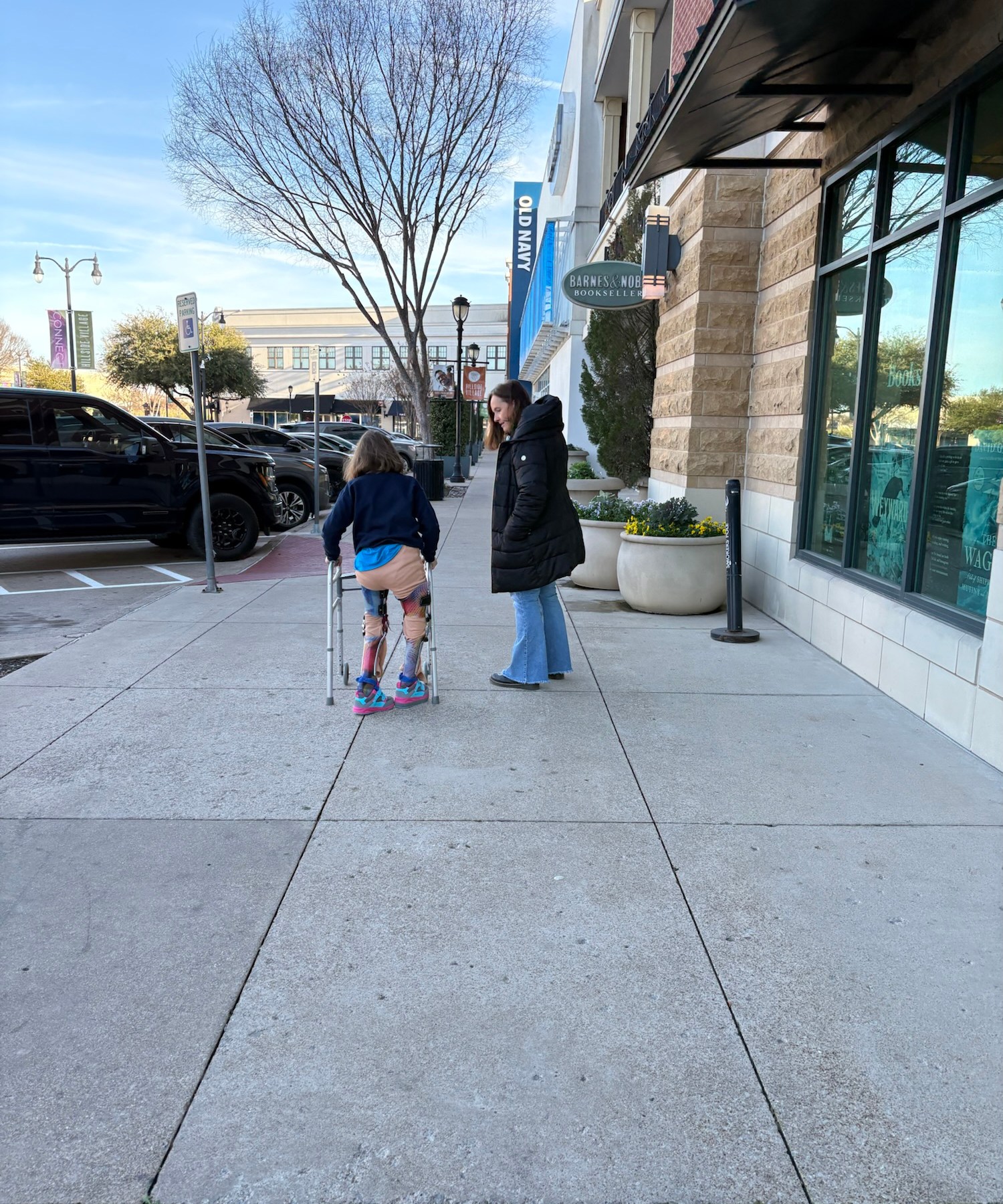
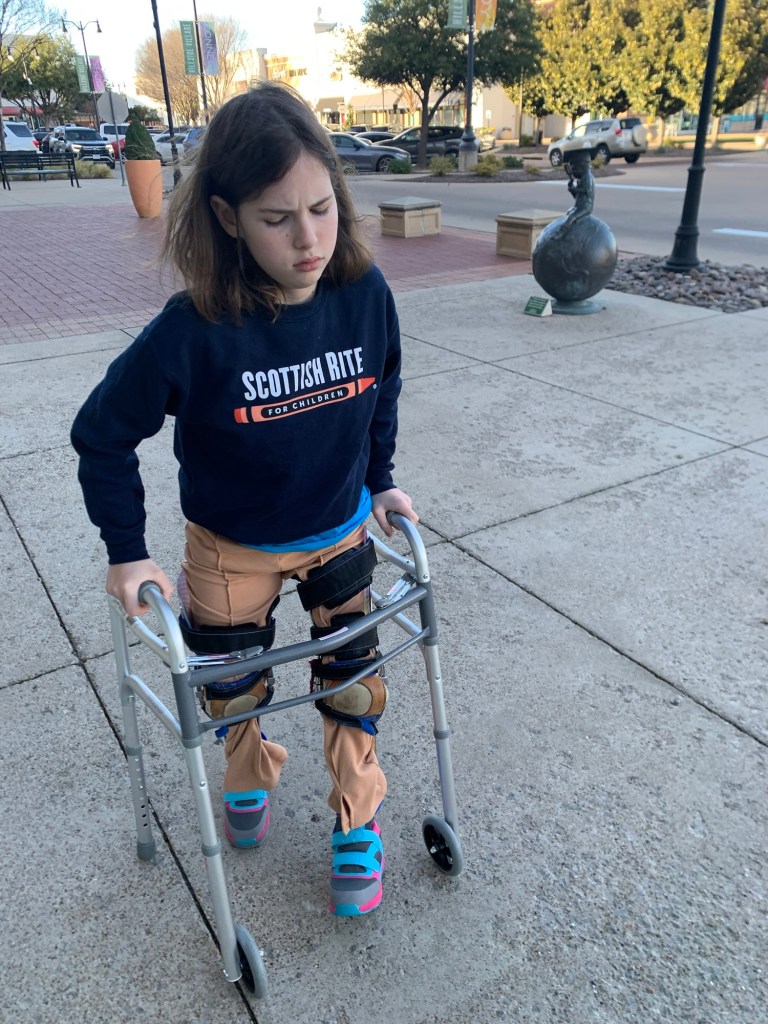
Things are looking a little better this week. Helena is up and moving! Helena already has forearm crutches and a wheelchair. Now she has a walker.
She is pretty unhappy with having to use a walker- “I look like an old lady.”
That is one frustrating stigma. People should be able to use the medical equipment they need without shame or fear of teasing because it doesn’t look “cool.”
There are lots of stories out there about people not wanting to use walkers for the reason that “walkers are for old people.” Just Google “walker stigma” and see what comes up.
There is also data that mobility issues are worsened by people avoiding using walkers, even avoiding treatment due to social stigma.
Walkers are an assistive device for anyone who needs them. They are not a part of the “elderly ensemble.” Walkers are for the safety of a person who refuses to quit moving and wants to continue participating in the things of their world. Being up and moving with an assistive device at any age is a sign of strength- not weakness. It would be much easier to not try, and many choose that to avoid stigma.
Not this girl!
She has overcome another obstacle, this one arguably much scarier than any other of her medical procedures- and has surgery on the other leg coming very soon.
We are happy she is putting weight on it now- but no bending for a while longer. She is a trooper!
Helena Update
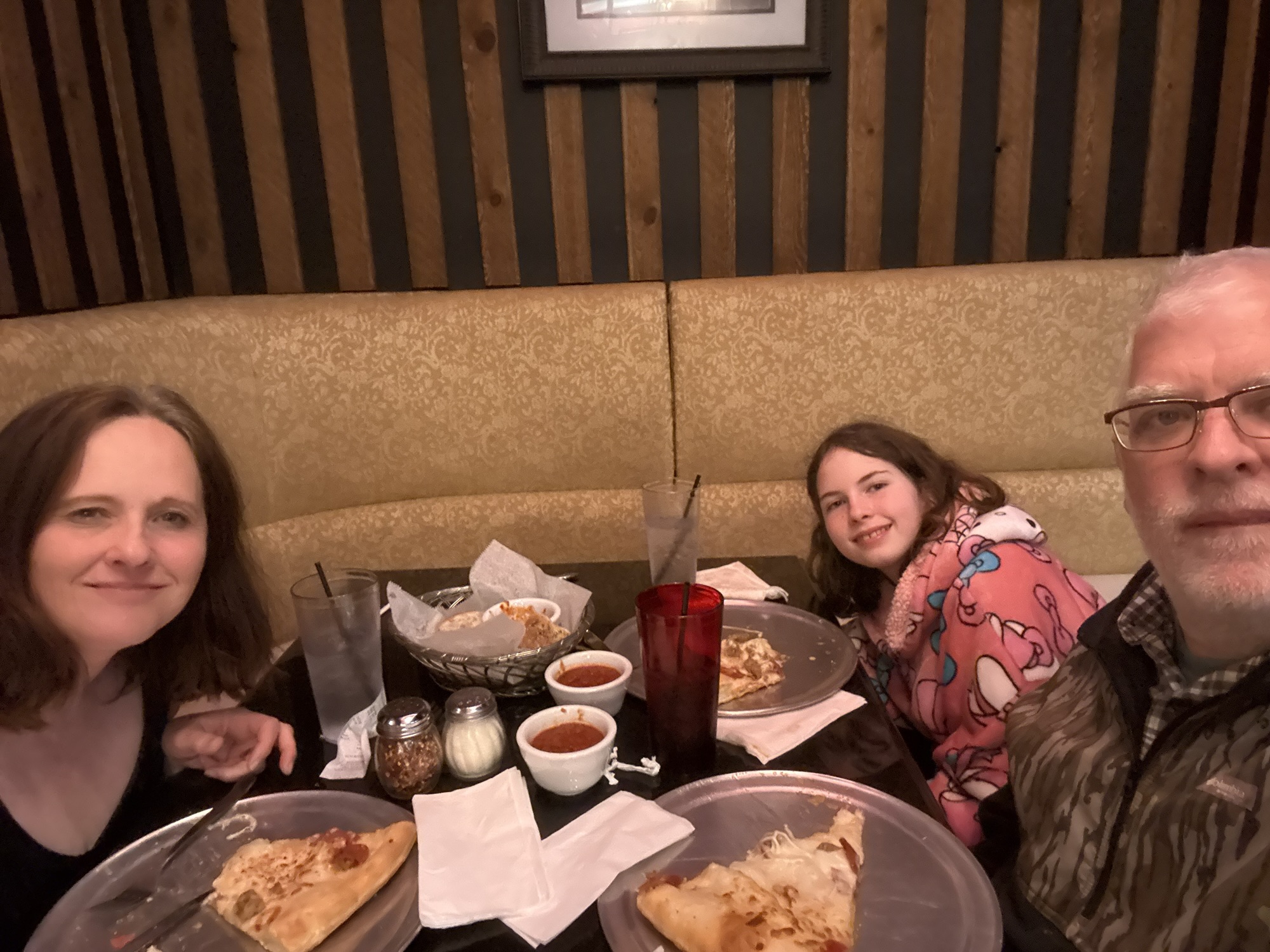
We had a Dallas appointment again today.
In the past 2 months we have been back and forth to the hospital 5 times, been at the ER, stayed in Ronald McDonald house for 3 stays, had 2 surgeries (one to fix a problem we weren’t expecting). We have extended our recovery time by an undetermined amount due to a pause in physical therapy due to these complications.
To say it has been stressful due to this process and the holiday season would be woefully inadequate. It is hard to put the stress of the past few months into words – we have trouble putting this into words even to each other. The best part of the past few weeks was definitely visiting with family. 😉
We always try to have some fun every time we come up to Dallas- and our favorite activity is going to Barnes and Noble. We go to every one we can find in our path – and we have visited several. Every one is set up differently, which makes it more interesting – and the sales at each are a little different. We have gotten family games on clearance for a few dollars (normally over $50). Today we got some fun Schleich dinosaur toys on clearance for $2 each (normally $24 a piece!) I plan to use those with my ALE kids during music. Lots of fun! 🙂
We are tired and we are not done.
Yet for now, things are spinning in a positive direction. Thank you for your prayers, and please keep thinking of us- we are not done with this recovery, and will have another big procedure not too far down the road.
Facing Surgery: The Concerns That Fill the Quiet Moments
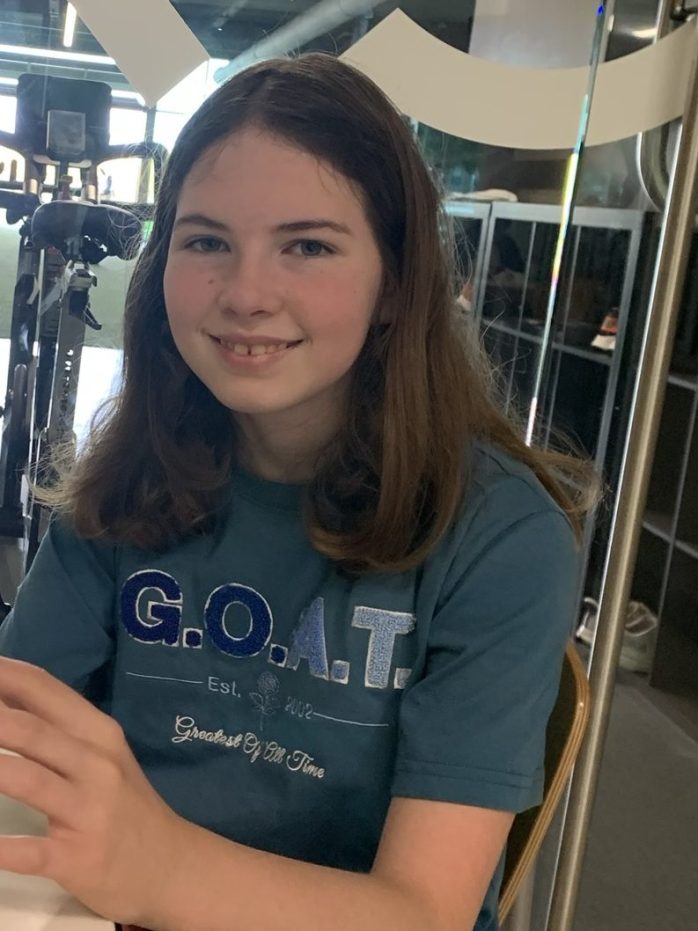
Helena is finished with school for November and facing a big event this week. She will be having surgery done on one or both of her knees.
We have known for a long time that this surgery would eventually happen, but not when or how exactly. We are now running out of time and options and it is time to act.
A lot is going through our heads right now. We are hopeful that the surgery will improve her gait and help her continue to walk as she grows. We know that she has the best doctors available. But we are also concerned, too.
Numerous Concerns – Big and Small
We have worries that range from silly to quite serious. We know she will be in a wheelchair for a few weeks. We don’t really know how to dress her during that time. She has been averse to dresses lately- but now we will likely be wearing them more.
We don’t know how mobile within the chair she will be. Will she have to have a lot of help with transfers to the restroom, bath, car. We don’t know what type of bracing she will have and if she will be able to move around easily.
We don’t know how long she will be in surgery and fear that we underestimate what is going on. What if they get in there and discover something about her condition that is bad news?
We don’t know how much pain she will have, and how she will handle it when she wakes up. (She is worried about the IV. We just had a short conversation about soreness at breakfast this morning. I’ve had knee surgery and hers is going to be more invasive. Pain will be a factor, but she doesn’t realize it yet.)
We are concerned about her missing school and how that will impact her academically, as well as emotionally.
Helena’s Concerns
Helena has been voicing her own concerns. I always reassure her, but it is worrisome to hear what she is voicing:
I don’t want them to put the “straw” in my arm. (The IV)
What if the doctors make a mistake and hurt me?
Will I have to have help going to the bathroom at school?
What if I die?
If it’s not going to “work,” then why don’t we just get me an electric chair? Then I don’t have to have surgery.
The work “work” in this case has a different meaning. We know that Helena will still require bracing to walk. Her body needs some adjustment as she grows to continue walking. “Work” in this case means that she is still able to do the things she is currently able to do. Still, it is hard for a kid (and most people, really) to understand.
Expecting the Unexpected
Because we have been talking about this surgery for 7 years, we have met with the doctor with many questions. Even now, we question whether we are making the right choice. We know that even now, we don’t know everything we would like to know. Surprises still come up in the process.
Last week, I was in a meeting at work and got a phone call from her surgeon’s nurse. Two or three calls in short order, to be precise. I continued working with my cohort, knowing I was about to go meet a hurdle head on.
As I left the meeting, my husband called. They needed a surgical clearance at the last minute from another specialist. I had to call to get them to clear her or get another appointment between then and the surgery. Basically- that was 7 working days from the day of surgery. How in the world am I going to get an appointment that fast? It’s a specialist- and I can’t even get into my primary care doctor that fast.
I called the doctor’s office. After some finagling and (ahem) maternal persistence, I managed to get an appointment with him. The appointment was at a clinic farther away than the one we normally go to. We both had to take off another day of work- this was totally unexpected and last minute.
That is how these things often work for people who have kids with special medical needs. Things are never simple- there is always a battle to fight or something else going on. Things don’t ever run smoothly, so you always feel behind or like you fall short. This is something to know about when you notice a special needs parent who seems “distant” or frazzled.
Fortunately, scheduling worked in our favor this time. Three different teams of doctors are working on this surgery. It was hard for them to agree on a date. Who knows what have happened if they hadn’t?
As Helena has grown, the surgery originally discussed seven years ago has become more invasive. We know that a whole committee of doctors has met, discussed, and planned what will be happening. She could not be in better hands than this the team of doctors. We know this and are grateful, and yet we also still have concerns.
A few days ago, I took pictures of Helena’s legs. I don’t know why it seems so significant to me, but I know they will never look the same. They will have new scars. They may not work in the same way when she is not wearing her braces. In my mind, I know that how they are now will be forgotten as they are unless I document them. I want to remember every stage.
We also know we are moving ahead, and this is a positive.

We are soaking in family time, building up each other, and prioritizing family moments this weekend. We are concerned, but we are going to be okay. We are facing this together. Please pray for Helena this week. 🙂
Pause Before You Approach
When a child’s differences are visible, respect from others should be visible, too.

A few weeks ago, my family took a trip down to the “Come and Take It” Festival in Gonzales, Tx. We enjoyed catching up with one of Stuart’s oldest friends and visiting vendors, attending concerts, and shopping in the quaint antique stores along the square. We also enjoyed eating at some of the local restaurants- one of which is “Cow Palace,” the restaurant associated with the local cattle auction.
While we were waiting for our food at “Cow Palace,” a woman walked up to our friend and said, “Excuse me, may I please speak to your daughter?”
Our friend said, “Well, she is actually my friend’s daughter.” They looked at me as I looked to Stuart. I am sure I had a look of concern in my face. Stuart had the same look on his face.
“That is fine, go ahead.” One of us answers. (I can’t remember which of us said it.) But I do remember- I was ready to pounce if things went wrong.
“Young lady, I am a special education teacher and have been watching you and I am so impressed with how you are getting around- you be sure to keep doing all of the things your therapists and teachers tell you, and you are going to do great things.”
I was relieved that this was what she said, although it was a little out of touch and she talked down to her a bit. However, it could have been much different- and much worse.
We have had some pretty strange interactions with strangers who feel the need to approach Helena and comment to her about her condition. It is awkward in most cases- but in some of these interactions, it has been downright scary.
We of course have always had regular experience with people (children and adults) staring at Helena. Helena will personally tell you that often, the adults are worse than their children. I try to encourage her to smile and be friendly – but should I really have to teach her to do that? Stuart has threatened to teach her “the Jack in the box”. Whatever that is …
Why can’t people just be kind? Why don’t people teach kids how to treat the disabled – or anyone for that matter? Who wants to be stared at? Manners are supposed to be taught through modeling and instruction. This often isn’t happening, and the result is some pretty awkward interactions.
These are a few of the many instances we have experienced as we are out and about:
1. We’ve had a man sitting with his own child in one of the most diverse (aka supposedly most accepting- um, nope) malls in the Dallas Metroplex yell “Oh my God!” loudly as we walked past them following a doctors visit.
2. We once had a man stop us in Wal-Mart in his dirty work clothes from the biggest Waco recycling company to tell Helena he was thinking of ending his life. He then saw her, and “realized that he can go on.” He then hugged her before I could move her away. This was obviously a very awkward and inappropriate interaction – and it sort of scared me.
3. We recently went to one of our local Christian thrift stores and a man called her over to tell her that if she fasts for 3 days that the Lord would heal her legs. I objected to his words strongly, told him “that was enough,” then exited the store. Helena was very confused about what fasting was and how it could help. I was very mad that some stranger felt like this was appropriate to say to a little girl.
4. On another occasion, a store clerk started asking me questions about “what was wrong with my daughter” repeatedly while Helena was standing next to me. I gave her my brief and simplified answer, but she continued asking questions for several minutes. She asked whether she was cognitively impaired (in front of her), asked what caused it, asked if she would get better, asked if a doctor could make her look “normal.” I don’t mind educating people, but the way she asked the questions was rather rude and poorly handled in front of Helena.
Lately, Helena has been asking a lot of questions and getting more of a realization of her limitations and how they affect her. She is noticing how others treat her, and it affects her emotionally.
She notices some kids moving away from her when she sits down and believes that it often has to do with her difference.
She notices kids staring at her at school and in the store. I am often there, and recognize that if I weren’t there, the stares would be condemning.
She wonders what type of car she will drive.
She asks about if she will be able to have children when she grows up.
She realizes she will never serve her country like her brother and sister do, and she is so proud of them.
She is growing up and starting to realize the world isn’t a place built for people like her. She has to make her own way, and often does.
She is realizing that people think she is broken and in need of fixing.
As she grows, we are very aware of the ways we can and can’t help her. We can guide her and make sure she has what she needs. But we can’t control the way the world responds to her. We can’t protect her from every rude or unstable person she will come into contact with.
For me, that is where God is going to have to come in. Only God can fill the void where we can’t. Only God can give her the right words, the assertive confidence, the right friends, the right disposition. And only God can show us how to best help her.
As her mom, I am praying for her a lot. I am seeking His guidance on how to help her. I believe that just as He did with my other kids, He is going to mold her into one of the most amazing human beings ever to walk the planet. A person who makes a difference for others.

Later on the same day at the “Come and Take It” festival, we got to watch the Shiner Hobo Band. One of the members saw us before the program and asked Helena if she’d like to direct the band. At first she said no. But after some serious bribing by her daddy, she went up, directed the band and had a wonderful time!
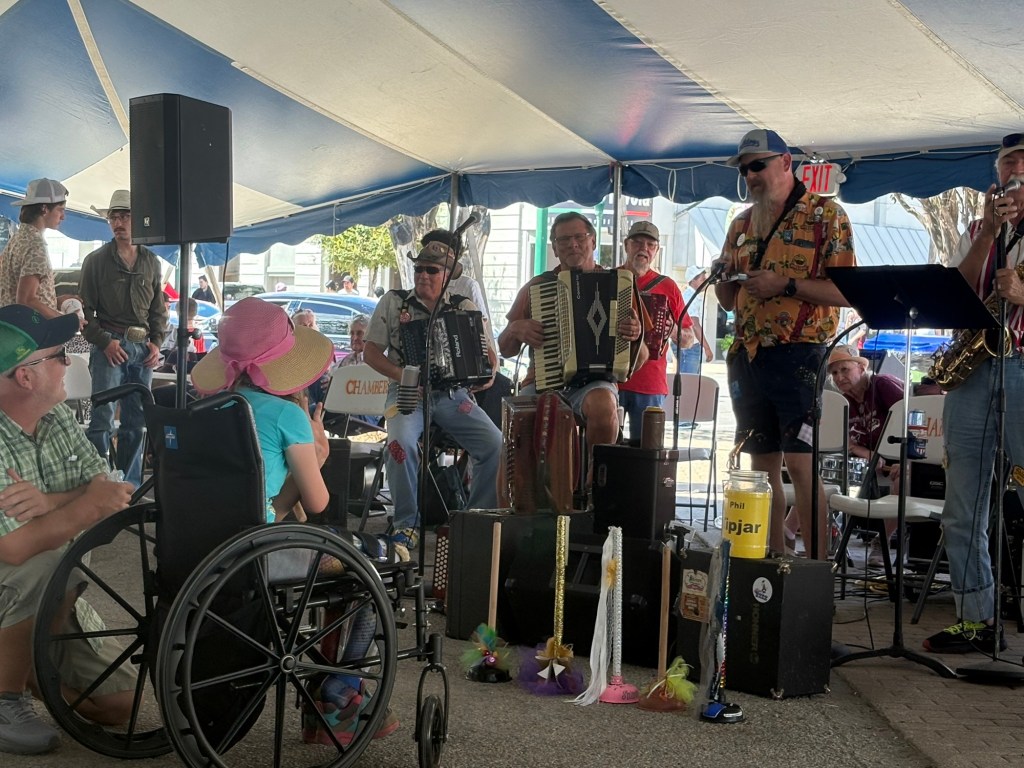
Shiner Hobo Band
Toward the end of the song, an odd little man came up and started asking Helena to dance with him. Her daddy was right next to her and was friendly, but even after she was done up front, the man followed her back to our seats. He was difficult to understand, and kept babbling on to her something about wanting to dance with her. That feeling of dread began to wash over me again.
A friendly man named Camarillo was sitting next to us with his aging parents. We had spent a lot of time talking throughout the concert. He knew about the community we are from and had worked in the area on some short term assignments. He had quit his job to be close to his parents. He was clearly someone with a mindset of compassion and put the needs of others first. (Camarillo is also a very large man who could have taken out the Rock if he wanted to…)
As we watched the odd little man closely, Camarillo called out in Spanish, “You may talk to her but do not touch her!” The odd little man didn’t listen. He finally grabbed her by the hands. Stuart and I were both in shock and about to do something when Camarillo said, “That’s it,” and quickly stood up. He walked around and sternly told the man in Spanish- “It is was okay to talk to her but do NOT touch this child. You are out of line. Leave her alone.” The man smiled, nodded at us, and was on his way.
“Thank you so much,” I said.
“No problem- I have disabled friends and family and have done the same for them.”
It was no accident he was there. Camarillo was a blessing – and a reminder that God sees us and puts the right people in place at the right time. Some people like Camarillo get it.
We are so grateful to people like Camarillo, to the elderly grandmothers at football games and church, to friendly faces and cheerful greetings that are sincere – and to those friends and family who see Helena for who she truly is – a typical kid with a rare challenge- and help us to raise her well and not just fix her. We are thankful for the people in Helena’s life who intentionally create an environment of respect – and know how to make Helena feel she belongs.
Facing Truth
I try to model positivity and a “can-do” attitude regarding Helena’s condition. However- there are times when reality seems to be more painful and moments when the emotions that I can typically keep under control seem to unravel.
Today was one of those days.
I went out to watch Helena run with her classmates at a school fun run today. She had a fundraiser like this a couple of years ago, just before the pandemic hit. It was a lot of fun to watch.
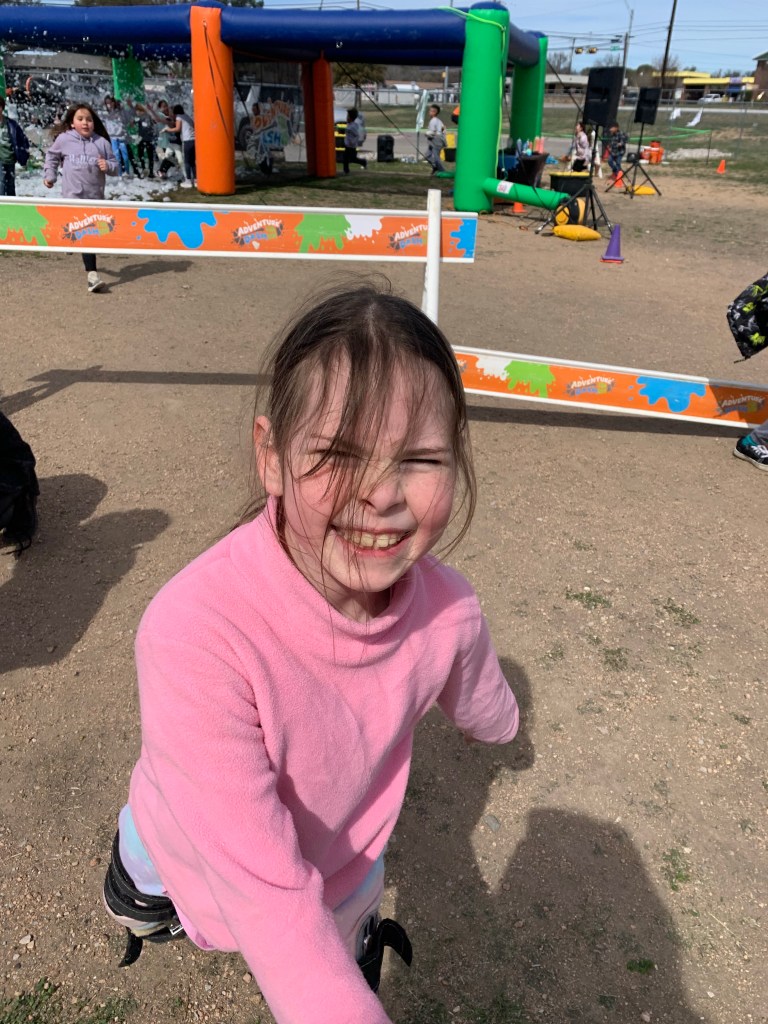
It was chilly outside, and yet Helena was overjoyed to be out there running, playing, being with her friends, anld experiencing the foam party. She was so determined to be at that foam party I spotted her a second donation to achieve it for her. She was giggling, socializing, and having a wonderful time. She was making the most of her experience.
As I watched her, however, I became increasingly sad and angry at her disability. I felt a sense of loss for Helena. I felt powerless.
She ran toward her first obstacle, an inflatable mountain that she was supposed to climb over. She started, and couldn’t get over it. Other kids came , climbed over, and she was still there trying to get up. It seemed impossible for her – and yet Helena, as usual, was determined to do the obstacle. After two or three rounds of kids overcame her, I encouraged her to skip the obstacle until fewer kids were there – but she wouldn’t be able to get over it without help. It took two adults to accomplish her getting over.
It was very discouraging to me.
It was a normal day for her.
She was having the time of her life. Unbeknownst to her- I was grieving the increasing disparity between her abilities and those of her classmates.
Helena couldn’t do several of the activities on the course. She couldn’t climb the inflatable mountain. She couldn’t jump the hurdles. She fell a lot. She was passed up constantly. She was left behind. This was more apparent this year than at the last fun run. Yet she was just so happy to be out there. She was giving it her all.
Helena had no idea I how sad this made me feel. I am the one who should set the tone for her. Sorrow for her circumstances is not an acceptable display for a parent raising a disabled child. Yes- it is okay to feel sad, and it is okay to be upset – but it is exceedingly unhelpful to her mindset to see me showing these feelings. Without her knowing – I was falling apart on the inside and it was visibly spilling forth in front of others.
I kept thinking – I won’t always be there to help her. I can barely help her now.
Helena has always been accustomed to finding workarounds to physical challenges. She knew she would eventually be able to get over the inflatable mountain- and without the large number of kids going at the same time- she knew she might even be able to make it without help. Helena exhibited the positivity we have encouraged her to have and will continue to cultivate.
I am always aware of her challenges and the difficulty she has with physical tasks – but do not always see these challenges in the obvious way this event displayed them. She does what she can while everyone around her passes her up. She does this with a smile on her face- just happy to be out there. I am grateful for her joyful attitude.
However, I do frequently grieve the struggles she has with simple childhood experiences. As I watched her, I felt the questions once again overflowing from my pent up emotions.
God- why? Why does Helena have to work twice as hard as everyone else? Why does she have to suffer while trying so hard to catch up, when there are others who won’t even take the steps to begin a challenge? Why does she have to deal with mean kids?
Why does she have to deal with the stares and whispers, the pitying. Why does she have to deal with insensitive comments? Why is this something that has a purpose in your plan? It doesn’t seem like it is useful to me at all. Why does she have to carry the burden of a disability? Why does any kid have to bear this burden of disability? Isn’t life hard enough?
How do I keep the joyful spirit I saw out there today joyful, and not turn bitter? How do I smile and not be upset when I have told her to smile and keep on moving? How do I set the tone of positivity if I don’t feel positive? Please- can You strengthen me in this?
There are many passages about tribulation and suffering in the Bible, and here is one:
“And not only this, but we also exult in our tribulations, knowing that tribulation brings about perseverance; and perseverance, proven character; and proven character, hope;”
Romans 5:3-4 NASB1995
I have this passage highlighted in my Bible, and I love it. But somehow, the tribulation Helena has seems to be a little over the top. Why does a child have to be born with any form of disability or illness? It’s unfair and I’m angry!
As she grows and her peers pass her up- my anger grows with her.
I think it is really uncomfortable for other people to see her falling behind as well, and then when they look at me and see the flood of emotions it makes them even more uncomfortable. I try to stay positive, but sometimes the reality is that this is our situation and it is difficult.
I don’t like other people seeing this side of me and it is difficult to find people who can relate to this situation. It is a lonely place to be – I can’t adequately verbalize the pain.
I suppose the best imagery is the fun run itself. Helena has always been behind her peers physically. Her peers will likely meet setbacks or injuries along the way – and she may somehow gain a bit of ground in the race. But ultimately, they will heal, grow stronger, and move further past her physically. She will fall farther behind.
I am sure there are times when people wonder- why bother with physical activities? She shouldn’t have to keep pace. And this is true- but I will never tell her she is not allowed to run the race. She truly wants to run the race and has as much or a right to run as anyone else. I watch this happening – and it is hard.
During these times when the disparities are hard to look past, a shadow looms over me and I can’t seem to shake it off.
That is when for me, it helps to retreat and pray. As much as I know it can help to have others to pray with – solitude many times feels the most comfortable. Helena stayed with grandparents this evening, so I was able to just sit, pray, and dwell on my sorrow. I have found that I can’t bury sorrow – it is better to just experience what I’m feeling and pray my way through it.
I try to be positive, and mostly- try to live joyfully. Helena is such a blessing to our family.
But sometimes- I’m just not feeling it. And that is okay.
 Without a Paddle
Recent Comments