Without a Paddle
Ponderings of an Uncommon Life
Pause Before You Approach
When a child’s differences are visible, respect from others should be visible, too.

A few weeks ago, my family took a trip down to the “Come and Take It” Festival in Gonzales, Tx. We enjoyed catching up with one of Stuart’s oldest friends and visiting vendors, attending concerts, and shopping in the quaint antique stores along the square. We also enjoyed eating at some of the local restaurants- one of which is “Cow Palace,” the restaurant associated with the local cattle auction.
While we were waiting for our food at “Cow Palace,” a woman walked up to our friend and said, “Excuse me, may I please speak to your daughter?”
Our friend said, “Well, she is actually my friend’s daughter.” They looked at me as I looked to Stuart. I am sure I had a look of concern in my face. Stuart had the same look on his face.
“That is fine, go ahead.” One of us answers. (I can’t remember which of us said it.) But I do remember- I was ready to pounce if things went wrong.
“Young lady, I am a special education teacher and have been watching you and I am so impressed with how you are getting around- you be sure to keep doing all of the things your therapists and teachers tell you, and you are going to do great things.”
I was relieved that this was what she said, although it was a little out of touch and she talked down to her a bit. However, it could have been much different- and much worse.
We have had some pretty strange interactions with strangers who feel the need to approach Helena and comment to her about her condition. It is awkward in most cases- but in some of these interactions, it has been downright scary.
We of course have always had regular experience with people (children and adults) staring at Helena. Helena will personally tell you that often, the adults are worse than their children. I try to encourage her to smile and be friendly – but should I really have to teach her to do that? Stuart has threatened to teach her “the Jack in the box”. Whatever that is …
Why can’t people just be kind? Why don’t people teach kids how to treat the disabled – or anyone for that matter? Who wants to be stared at? Manners are supposed to be taught through modeling and instruction. This often isn’t happening, and the result is some pretty awkward interactions.
These are a few of the many instances we have experienced as we are out and about:
1. We’ve had a man sitting with his own child in one of the most diverse (aka supposedly most accepting- um, nope) malls in the Dallas Metroplex yell “Oh my God!” loudly as we walked past them following a doctors visit.
2. We once had a man stop us in Wal-Mart in his dirty work clothes from the biggest Waco recycling company to tell Helena he was thinking of ending his life. He then saw her, and “realized that he can go on.” He then hugged her before I could move her away. This was obviously a very awkward and inappropriate interaction – and it sort of scared me.
3. We recently went to one of our local Christian thrift stores and a man called her over to tell her that if she fasts for 3 days that the Lord would heal her legs. I objected to his words strongly, told him “that was enough,” then exited the store. Helena was very confused about what fasting was and how it could help. I was very mad that some stranger felt like this was appropriate to say to a little girl.
4. On another occasion, a store clerk started asking me questions about “what was wrong with my daughter” repeatedly while Helena was standing next to me. I gave her my brief and simplified answer, but she continued asking questions for several minutes. She asked whether she was cognitively impaired (in front of her), asked what caused it, asked if she would get better, asked if a doctor could make her look “normal.” I don’t mind educating people, but the way she asked the questions was rather rude and poorly handled in front of Helena.
Lately, Helena has been asking a lot of questions and getting more of a realization of her limitations and how they affect her. She is noticing how others treat her, and it affects her emotionally.
She notices some kids moving away from her when she sits down and believes that it often has to do with her difference.
She notices kids staring at her at school and in the store. I am often there, and recognize that if I weren’t there, the stares would be condemning.
She wonders what type of car she will drive.
She asks about if she will be able to have children when she grows up.
She realizes she will never serve her country like her brother and sister do, and she is so proud of them.
She is growing up and starting to realize the world isn’t a place built for people like her. She has to make her own way, and often does.
She is realizing that people think she is broken and in need of fixing.
As she grows, we are very aware of the ways we can and can’t help her. We can guide her and make sure she has what she needs. But we can’t control the way the world responds to her. We can’t protect her from every rude or unstable person she will come into contact with.
For me, that is where God is going to have to come in. Only God can fill the void where we can’t. Only God can give her the right words, the assertive confidence, the right friends, the right disposition. And only God can show us how to best help her.
As her mom, I am praying for her a lot. I am seeking His guidance on how to help her. I believe that just as He did with my other kids, He is going to mold her into one of the most amazing human beings ever to walk the planet. A person who makes a difference for others.

Later on the same day at the “Come and Take It” festival, we got to watch the Shiner Hobo Band. One of the members saw us before the program and asked Helena if she’d like to direct the band. At first she said no. But after some serious bribing by her daddy, she went up, directed the band and had a wonderful time!
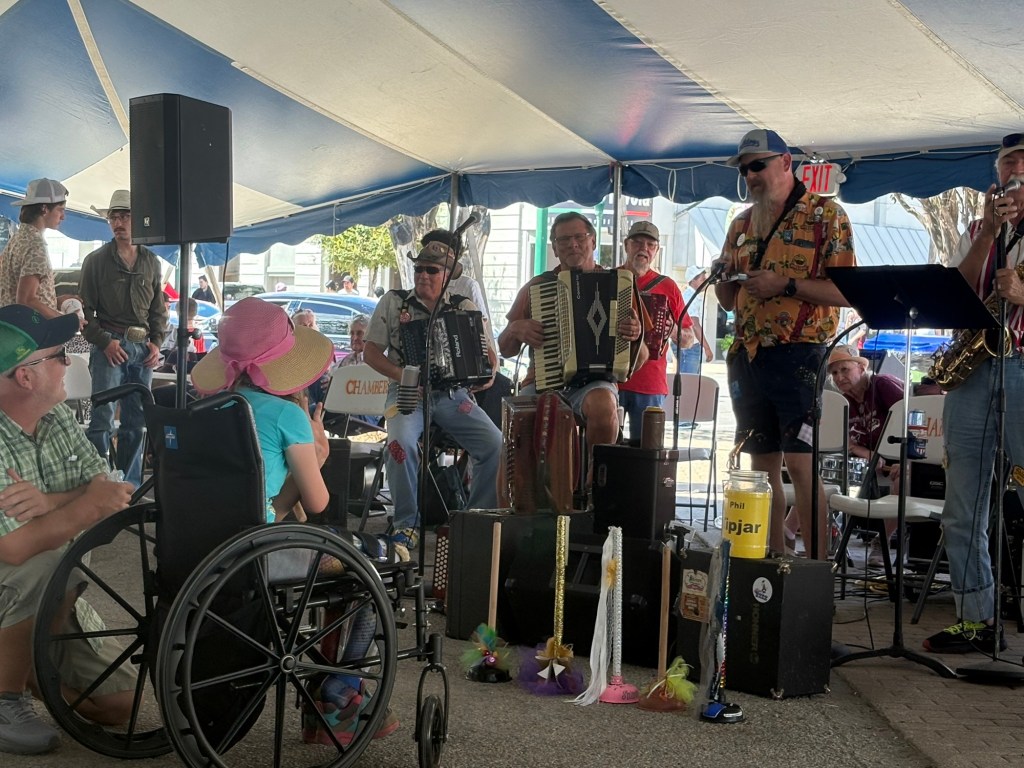
Shiner Hobo Band
Toward the end of the song, an odd little man came up and started asking Helena to dance with him. Her daddy was right next to her and was friendly, but even after she was done up front, the man followed her back to our seats. He was difficult to understand, and kept babbling on to her something about wanting to dance with her. That feeling of dread began to wash over me again.
A friendly man named Camarillo was sitting next to us with his aging parents. We had spent a lot of time talking throughout the concert. He knew about the community we are from and had worked in the area on some short term assignments. He had quit his job to be close to his parents. He was clearly someone with a mindset of compassion and put the needs of others first. (Camarillo is also a very large man who could have taken out the Rock if he wanted to…)
As we watched the odd little man closely, Camarillo called out in Spanish, “You may talk to her but do not touch her!” The odd little man didn’t listen. He finally grabbed her by the hands. Stuart and I were both in shock and about to do something when Camarillo said, “That’s it,” and quickly stood up. He walked around and sternly told the man in Spanish- “It is was okay to talk to her but do NOT touch this child. You are out of line. Leave her alone.” The man smiled, nodded at us, and was on his way.
“Thank you so much,” I said.
“No problem- I have disabled friends and family and have done the same for them.”
It was no accident he was there. Camarillo was a blessing – and a reminder that God sees us and puts the right people in place at the right time. Some people like Camarillo get it.
We are so grateful to people like Camarillo, to the elderly grandmothers at football games and church, to friendly faces and cheerful greetings that are sincere – and to those friends and family who see Helena for who she truly is – a typical kid with a rare challenge- and help us to raise her well and not just fix her. We are thankful for the people in Helena’s life who intentionally create an environment of respect – and know how to make Helena feel she belongs.
 Without a Paddle
Recent Comments